Sunday, September 5, 2010

Week 7 - Lecture summary

Free culture, free society

"Our current culture is one in which creators get to create only with permission
of the powerful, or of creators from the past"

- Lawrence Lessig


Creative Commons is a non-profit organisation dedicating to promoting reasonable copyright. They help creators make their work available in more flexible ways by developing standard licences and tools. This way they enable "some rights reserved" instead of "all rights reserved".

Once upon a time all software was free, and everybody could alter it and make improvements to it, reuse it and share it. About the same as an open air market or sharing your favourite food recipes with friends. Almost 20 years ago, Richard M Stallman started the Free Software Foundation. Like "the good old days", his aim was to create an operating system based solely on free software. His creation became GNU (GNU's-Not-Unix). This later became a part of the GNU/Linux Operating System, a highly successful alternative to MacOS and Microsoft Windows, that can be ran on almost any computer. During early 1990s, Finnish programmer Linus Thorvalds developed the experimental Linux and after inviting people to contribute this ended up as the GNU/Linux. Today this is used world wide and have a 30 % marked share.


So let's look at how software works. Instructions that are written in Programming Languages are called Source Code and tells a computer how to operate certain functions. The Source Code is then translated into files that can run on specific computers. However, most users are not aware that search engines and different apps run on FOSS. The basic principles of free software is a freedom scale from 0 to 3; from running the program to improving and releasing those improvements - giving the society the benefits of your work. To enforce these principles, Stallman created GNU Public Licence (GPL). This legal document con trolls what can and cannot be done with FOSS. Any attempts of stealing and selling software protected by GLP will end with lawsuit. It was this concept that inspired Lawrence Lessig to start Creative Commons.


Regarding proprietary software (Windows Vista, Office, Photoshop, MacOS), the Source Code is confidential, with legal protection and non-disclosure agreements. The software is created by paid staff employed by companies and then sold to the public. This way we don't actually own it, we just have a licence to use it. When we buy it, we sign an agreement and it is illegal to copy the software for your friends regardless of how much better the computer will work. If you experience problems with the software, you simply have to wait for the upgraded version and pay again!

In the free software (Mozilla Thunderbird/Firefox, Open Office, amsn) world, on the other hand, the Source Code is available. Under the GLP anyone can see/edit/use it and it is developed by volunteers in the society. Previous mentioned business model is providing services supporting this free software.


Our community can collaborate towards creating good things and how you use your computer is totally up to YOU not Apple or Microsoft. You have a choice - use it wisely!

TuteSpark


This week we were told to try out different open source software and compare this to proprietary software. I have MS Vista on my laptop, but have never liked the functionality of Internet Explorer. I have used Moxilla Firefox for a long time, and really enjoy it. I like the simple structure of this browser and think it's very easy to navigate. I'm sure the differences isn't that severe, but I guess it's a matter of what you are used to. Another plus for Mozilla Firefox is that I experience less downloading errors compared to Internet Explorer and it seems that Firefox is less likely to crash while you're on the web.

Another open source software I frequently use, is the VLC media player. In my experience, this player has hardly no errors, is very user friendly and you can pretty much play all the files you want on it. It also has a portable version, so you can watch movies on the go. Compared to the MS Windows Media Player I find VLC superior.

Finally, I downloaded Pidgin. After trying it out for a few days, I found that I like MS Trillian slightly better. For me, the design as well as the functionality is important, and Pidgin compared to Trillian was boring and didn't have as many functions.

Week 6 - Lecture summary

Media, New Media & Social Media


The definition of technology is "the scientific study of mechanical arts and their application to the world". This often includes objects and the knowledge of how to use them. When this technology is used to communicate it becomes a medium of communication.


New Media includes Virtual Community, which is a way of explaining a group of people who communicate via the Internet, and Individual ID, which is a way to explain HOW people present themselves online. People are given the opportunity to play around with their identity and the Internet works as a social lab where people can construct and reconstruct themselves. (Turkle, 1995, Life on the screen).

The virtual world was a way for people who where geographically isolated to get in touch with others with shared interests. Many early Internet books actually explore this fact. The social networking as we know it, have moved away from this group dynamics and has become an ego centric system that focuses on YOU as an individual.


After the dot com-crash in 2000, Tim O'Reilly & co. created "Web 2.0". This was a new way of thinking about the Internet. The "Web 2.o" is a technical definition describing technologies used to focus on the user experience regarding creation of web services. Features of this new way of looking at the web is among others; Folksonomy, which is a way of organising knowledge in the form of "tags". This way you are in charge of dividing the categories of your post, instead of some authority doing it for you. Making us producers as well as consumers, by letting us create photos, images, videos and text and upload them to the web. Finally, we can share data openly because of open API. The common element here, is community and collaboration. This now had became the Read-Write Web instead of the previous Read-Only Web.
Moving on into the social media world. This includes elements such as weblogs, or blogs, social network services and content sharing communities. There are some variations in the blog area, such as vlogs, mologs/microblogs (Twitter). Facebook, MySpace, Friendster and livejournal are all examples of social networking sites which have explodes over the last few years. YouTube, Flickr, Deviant etc, are popular sites where people share all kinds of content online.

Regarding people working in the social media field, this has changed over the last 3 years or so. Social Media Experts have become a "tool" for marketing people who wants to teach us how to operate Web 2.0 tools to promote our businesses and/or brands. However, how do these companies make so much money? Well, to get them to perform a service for us, we have to put "stuff" on their sites, so you can say that we are working for them.

The "Attention Economy" and the "Economy of Accumulation" are two concepts concerning our online networking society; Who wants information about us? People send out update emails on themselves (called Eyeballs), but who want these eyeballs, and what can they do with the information? We should ask ourselves how we would react if suddenly writings from our blog was in a newspaper, and we didn't receive any credit for it. In addition, what would we do if pictures we posted on our facebook-page appeared in a fancy magazine? The way we treat our privacy these days is certainly not very good concerning these issues. Maybe we're yelling a bit too loud to get peoples attention and in a way creating this problems for ourselves.


Tutespark


On the subject of online privacy; Who owns the content we put on the web? All the pictures, videos etc that we upload on different networking sites - is that really ours? And finally, who has the right to use these creations?


To figure this out, I went and took a closer look at Facebooks privacy policy;


Since one of the main reasons people are using networking sites such as Facebook is to share content with others, it is critical that they have a valid and reliable policy to prevent misuse of this content. Facebook haven't exactly received praise for their previous work in this area, but after some new adjustments it seems like it's as close to bulletproof as it gets. First of all, you have the option of choosing who you want to display your uploaded/shared content to. Second, Facebook lets you know that ANY content uploaded on this site can be copied and re-shared by other users. So there you go - pretty much anyone that knows how to work a computer can access your photos or other content that you choose to upload and have visible to others. This is why people need to consider what kind of material they include on their personal profiles.


Reference: Facebook Privacy Policy


Content uploaded on YouTube voluntarily may be used by others. In addition, YouTube may use any private information the users disclose to operate/maintain/ improve features of the site.


Reference: YouTube Privacy Notice


Sunday, August 29, 2010

Week 5 & 6 - Tutorial task

Since this week were all about Culture Jamming and its impact on the world, the task given was to make our own. In a group of four (Mia, Angela and myself) we started thinking about the best way of getting CNNs attention. Mia did not attend this tute, so the two of us began searching the web for material. After brainstorming and writing down several ideas, we could process it and come back to it the next day. We spent some time during the week and tried to figure out how to get CNN to contact us. The group figured that it would make most sense to use a celebrity or a case that was in the wind at the moment - this way it would seem more believable.

In the next tute I was sick, so Mia and Angela had to shoot the video for our story. They went to Angela´s house - this way the location was "real" - and shot some raw videos that Mia and I are going to edit and post on CNN iReport very soon.

This is our story-line:

Yesterday the Gold Coast Bulletin recieved a letter from a Miss Gretel Anderson, a former body sculpting champion, who claims to be having a relationship with the current priminister Miss Julia Gillard. Stating that she was sick of being left out in the cold by Miss Gillard and to feel ashamed about her sexuality, because it has never been acknowledge publicly. Miss Anderson also states that there relationship has been an on going affair for over 10 years, and she hopes that by finally speaking out about there love affair will bring out the importance of sexual discrimination and maybe bring about the legalising of gay marriage rights in Australia.

The finished product from YouTube:

Week 5 - Lecture summary

Consumers & Producers

For us to consume and enjoy different types of media, somebody have to produce it. When we go to the cinema, we can choose what type of genre we want to watch, but is our choices as wide as we might think? The answer is no. Our movie experience, regardless of genre, is in a way controlled by the dominant Hollywood Studio System. When you think about it, every aspect of our media consumption is controlled in some way; the news we read in papers or watch on TV is not all the news that is out there, but it is what the different media outlets choose to show us in the manner they prefer. The new communication technology is now changing this paradigm, and we are moving from being strictly consumers, to consumers and producers.


The Big Screens In Life, such as the cinema, TV and computers (Internet) are all outlets that lets us take in media in different ways. The Cinema and television makes us passive consumers because we’re being fed our entertainment through these channels. Computers, on the other hand, are slightly different in the way that we can seek out information (such as news) and therefore have a broader saying in what we watch. In addition, the computer is the gateway from consumer to producer, because people can produce media and use the Internet and the World Wide Web to distribute these products to other consumers.

Because of the growing convergence, the “small screens” such as Smart Phones and personal media players (e.g. Ipod) is giving this development a large boost. In approximately 4 years time, we have moved from just a few people having Internet access on their phones, to almost everybody. We are turning into active consumers by personalising our phones, pods & pads and this way it is solely up to us what we put on our devices. However, this can make us ignorant when it comes to new things so we just have to be careful not to get too personal. This improvement is important to be aware of, because it is a part of our future.

One example of people having an impact on the media is cell phone videos that are sent straight from phones and to different websites, news agencies and so on. This can occur when something dramatic happens, such as the tragedy of the Indian Ocean Tsunami in 2004. The news stations and journalists naturally did not have access to the trauma when it was happening, but people who were experiencing this dramatic event used their phones to document the severe damages made on both people and large amounts of land as the waves were crushing in, destroying everything in their way. This is an example sent to a French news channel:


This takes us to the next area of this lecture, Citizen Journalism. While professional journalists are bound by rules that decides what they can and cannot do, Citizen Journalists does not have those boundaries. In that way, it is a powerful concept and it can also be quite scary since people can post whatever crazy stories they want, and there will always be someone out there who will believe it.
CNN News even have their own "IReport", where Mo-Jo's (Mobile Journalists) or other citizens can publish stories and then CNN verifies them, or not. Blogs and online magasines are other examples of media outlets which is used.

Below I have posted a few videos that we watched towards the end of this weeks lecture. This is in context to Mash-Ups/Re-Cuts/Re-Genres, which basically means taking for instance a horror-trailer and making it into something else, and the Internet Short Films which is a growing consept. One portal for these types of films is - here you can find heaps of movies in all genres made for online distribution only.

This is an example of a well made cell-phone video:


Here is an example of a trailer that has been recut from horror to a family movie:


Regarding week fives TuteSpark, we were asked to play around with the term "Culture Jamming" and find the first, the most influential and the most damaging Jam. First of all, what is it? According to Wikipedia and The Center of Communication and Civic Engagement , it is a way of disrupting the branded environment which we live in by re-forming logos, fashion statements and product images made by different cooperations for advertising purposes. The jammers goal is to create political action and behavioural change in the general public.

In search for the first culture jam, I found that this is a concept tracing back all the way to the 1950s. The term was converted from its origin, radio jamming, and into culture jamming by the band Negativeland in the mid 80s, but the first jammers is a group called the Situationists.

I think the most damaging culture jams are those who have to do with war and destruction. They put our materialised world and mindset in perspective by altering ads such as the famous Ipod/IRAQ jam from Los Angeles, posted below. This definitely raises some issues that people need to consider.

It's a lot of influential culture jams out there, and I found it tough to find the one with most impact on society. What I did find, was a jammer named Jonah Peretti that made quite a fuss when he wanted customised Nike shoes with the word "Sweatshop" on them. He created an email exchange with the Nike web site, which had refused his request, and this email was then spread world wide to a huge population. Other influential jams could be the ones with fast food / disease alteration. More and more people are becoming ill or dies because of our fast-food society.


Monday, August 16, 2010

Week 4 - Tute Task

Q1

I thought that online video wasn't much of an issue before Chad Hurley, Steve Chen and Jawed Karim founded YouTube in 2005, but I was wrong.


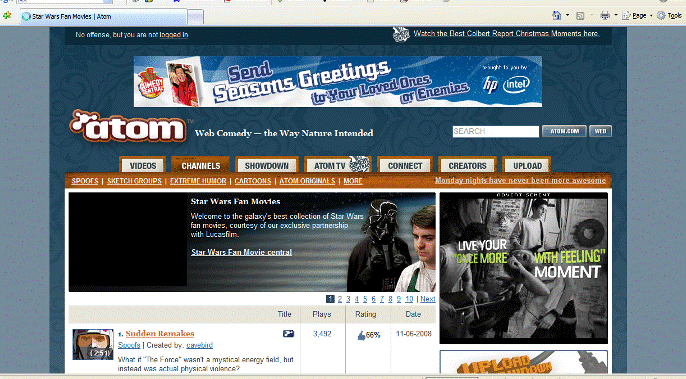
AtomFilms, a company founded in the late 90s actually played a huge role in kickstarting the online video industry. After being bought by MTV Networks in 2006, it was relaunched in 2008 as Atom.com - a stricktly comedy based site.

I tried to find the first video posted on AtomFilms, but sadly no luck.


Q2

Over a short period, several 3D-movies have been released in the cinemas all over the world. Alice In Wonderland, Avatar & the fourth Shrek are some examples. The amazing effects the 3D experience creates on a movie, is definately the producers way of luring us into the movie theatres. The industry needs this technology to drag us away from sitting at home, downloading the movies illegally onto our computers and in worst case, selling them to our acquaintances.

Q3

A lot of short films is still being produced world wide. Some are for advertising purposes and getting peoples attention. Different banks, insurance companies and even governments pay large amounts of money into different campaigns to get their message out to the consumers of media. Two examples of using fear to get people to wear seatbelts are shown below.

This example is made for AXA Insurance Company and DOE Australia:


This is made for Axon Youth Bank, and won several prizes at the Cannes film festival:


Q4

The word viral is being used in several ways, and in the movie world it usually refers to something being distributed and spread online. When talking about a video that "went viral", the link spread so fast from people to people that it became extremely popular "over night". One example of this type of movie is shown below.

This is an independent Star Wars fan - film created by Kevin Rubio in 1997:


Another example I had to include, is a home made video that was uploaded on YouTube and became extremely popular. It has been viewed 221,992,172 times! Several TV-shows have shown this video and someone actually made it into a song.


Q5

"Smosh" is a very popular show and a good example of a series that is solely made for distribution online. Here is one webisode from YouTube:


The positive about watching TV this way is that you don't have to worry about air times, and can spend your day as you please, then come home and watch your fav show whenever you want. The negative thing is maybe that the TV stations and production companies are loosing money because everybody now have access to shows online.

Week 4 - Lecture summary

From the BIG screen to the very small

28th of December in 1895 something amazing happened in the heart of France; The birth of Cinema. Since there had never been anything like a motion picture before, the cinemas in Paris were packed during the 20 minutes divided onto 10 short stories sent 10 times a day. After this huge success, the frenchmen decided to build a permanent movie theatre, and in 1897 they could celebrate. Now, people started producing movies. In 1903 the first real life-based film was released, and was the appropriate length of 10 minutes. "The Story of the Kelly Gang" was the first full-length narrative feature film, and this Australian made production was somewhere between 60-70 minutes long.

1913 was the year we were introduced to studio system. Producers discovered that filming inside a studio(on a set) instead of locations in the real world, could save them a lot of money - the industry certainly grew fast in the early 1900s.


Up till now, it would have only been silent movies shown in the theaters, so it was about time that in 1927 creators started experimenting with sound and making the very first "Talkie" with an actual dialogue (The Jazz Singer). People now started to realise that this was a mass form of entertainment from which they could earn massive amounts of money. So in 1929 the first 100% natural color talking, singing, dancing picture was released in New York City. In addition, the first ever Oscars award show happened in the Hollywood Roosevelt Hotel on May 16th same year.


Camden Drive-In, New Jersey turned out to be the start of another era in the history of the cinema; The Drive-In Theaters (1933).


A few years later, 1938 to be exact, Walt Disney with his "Snow White and the seven dwarfs" made astonishing 8 million dollars and the world was introduced to a new phenomena, the TV! This was becoming the future rival of the big screen, and the wonderful technology was first seen in Queens in 1939.

Since the cinema now officially had competition, Hollywood fought back and released feature-lenght 3D-sound films such as "House of Wax", in 1953. This was the movie-producers way of telling the people to get up from the couch, away from the TV and back into the movie theatres. Another attemt at filling the theatres again was to lure people with one good movie, a so called A-movie, and a second viewing of a more cheaply made movie, e.g. horror - because they were the cheapest ones and it seemed that they allways had an audience. This countermeasure made by the cinema, got the television world to think about showing movies on the TV. So instead of fighting, in 1955 the movie creators started licensing films to television stations and made even more money.

Taking the cinema experience one step further, why not build several big screens in the same building? And so they did. By 1965 the first multi-screen movie theatre opened in Kansas City and still to come was the Megaplex, with over 20 screens and stadium-style seating. Still in the 60s, the same company that developed the "practical videotape recorder" (1956) now had created their first consumer version f a videotape recorder, to the grand price of 30 000 dollars! A very consumer friendly price.. Later this same decade, Sony launched a portable and also very expencive black & white video camera system, video tape recorder, and took it one step further in 1969 when they introduced the VCR (Video Cassette Recorder) for home use.

The father of independent movies, John Cassavetes, opened the door to a whole new side of film industry. After some struggling actor days, he directed and financed his second film named "Faces" and on the casting list was among others, his wife. Moving on into the 70s, another independent movie by the name of Billy Jack was released as a Block Buster, which basically ment a simultanious release in several cinemas. Before this, they actually had to drive the rolls of film from town to town and have a few days of viewings before going to the next movie theatre.


Another major event in the early 1970s, was the premiere of the IMAX widescreen format in Japan. This is an ridiculous big screen and they even had own cameras to make the IMAX movies.

In the late 70s and early 1980s, we were briefly introduced to "DVDs" the size of records, better known as laser discs, and this could have been the end of the VHS, except there were no recording opportunities on them. Following, the MTV was born in 1981 and in 1983 the first coin operated, laser disc arcade game Dragons Lair, was released. In 1985 video film became popular, and the producers launched movies, mostly cheap horror productions, directly on discs, because there were no point spending money on releasing them in theatres (which is still being done today).

Regarding this weeks TuteSpark, we were asked to find 3 films that have been made especially for the Internet and distributed online. These are my findings:

This is a powerful short film, that tells the story of two brave men facing a fear:


This is a movie made by Pixar, as a form of online advertising:


The next movie is also in the comedy genre:

Sunday, August 15, 2010

Week 3 - Treasure Hunt

Q1


The Bagger 288 is the largest machine on the planet. It weighs 45,500 tons and cost 100 million dollars to build.

http://www.neatorama.com/2010/01/26/bagger-288-the-worlds-biggest-machine/
http://www.michaelgriswold.com/Pictures/ALL/bagger/bagger.html

9th of August

Q2

The best way to contact Ozzy Osbourne is through Twitter.

13th of August

Q3

The first form of global digital communication, is the Internet. The idea and research originated in the US in the 60s.

Q4

The cheapest form of travel from Gold Coast to Melbourne is by plane.

13th of August

Q5

Hatsune Miku was born at the 31st of August in 2007 and is the first, most popular installment in Vocaloid Character Vocal Series. This is a singing synthesizer application made by Yamaha.


9th of August

Q6

Live webcam feed from The Mawson Station which is part of the Australian Antarctic Division. (Picture taken from the Casey Station at its coldest)


Just for fun, I also found a time lapse movie from the webcam at the Amundsen-Scott South Pole Station.

9th of August

Regarding a place to stay in Antarctica, one recommendation is the Norwegian owned Polar Star Ice-Breaker, which is a ship that will take you to several locations during your stay.


14th of August

Q7

The song was on top of Australian pop charts two out of four weeks in August 1980, was Lipps Inc - Funkytown

28th of August

Q8

The first thing that comes to mind when defining “nano technology” is the Ipod Nano from Apple.
You can pretty much do anything on this little piece of technology, and because of that, I think nano tech refers to a small, but certainly ground breaking way of creating new devices with very "little" material. After reading about it at encyclopedia.com, I found out that it is in fact tiny, but very amazing technology. The concept is built on molecular manipulation abilities; atoms large enough so that they can be placed in layers creating machines and computers in so called nano-scale.

9th of August

Q9

The camera used in Google Street View is an Immersive Media 360. This amazing camera named Dodeca 2360 Camera System is easily attached to automobiles, and delivers the astonishing number of 100 million pixels!


14th of August

Q10


1. nuq 'oH vo' chay' 'ar ta'ta' 'oH Daq chen

2. nuq 'oH HochHom Daq

3. ghorgh 'ej nuq ghaHta' wa'DIch vo'

4. nuq 'oH vo' vo' SuD baS Daq

5. 'Iv 'oH nuq ta'taH ghaH Daq nuq 'oH Daj qoS

6. tu' yIn Daq tu' Daq Daq Daq

7. nuq bom ghaHta' vo' vam Daq

8. chay' SoH Daq lIj ghaj mu'mey nuq ta'taH 'oH

9. nuq vo' 'oH Daq chenmoH

10. Dochvammey Daq tlhIngan.


Translated by MrKlingon.

17th of August